The Crispy Fried Chicken Status Board
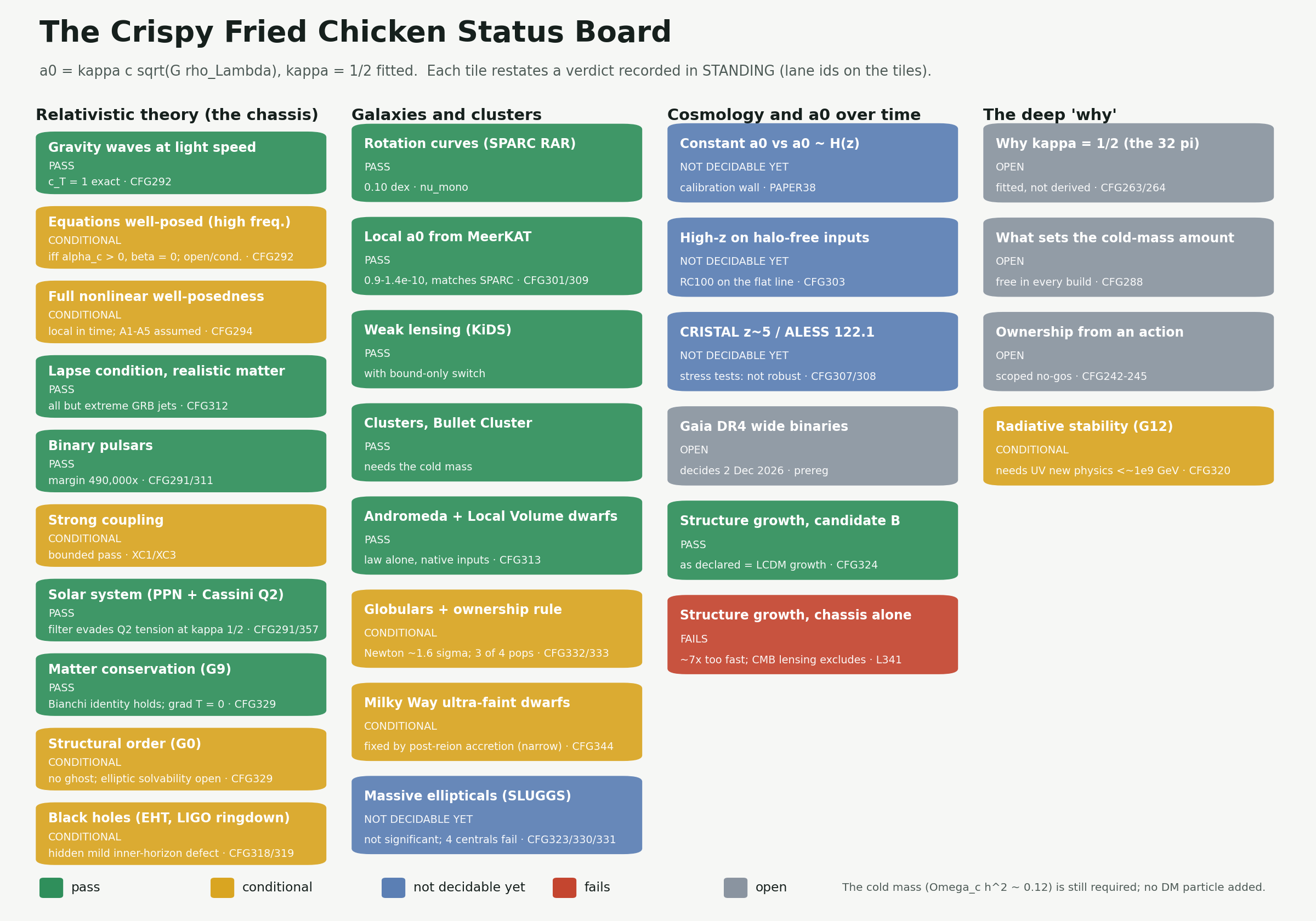
One claim: a₀ = κ c √(G ρΛ), with κ = ½ fitted, not derived. A cold component of mass (Ωch² ≈ 0.12) is still required, and no dark-matter particle is added. Every tile restates a verdict from a committed script whose pass/fail rules were frozen before the data were read. Updated 5 October 2026.
Pass
Gravity waves at light speed, binary pulsars, solar-system tests, matter conservation, rotation curves (SPARC), local a₀ from MeerKAT (0.9–1.3 × 10⁻¹⁰ m/s²), weak lensing, clusters, Andromeda and Local Volume dwarfs, and candidate B’s large-scale structure growth (it matches ΛCDM and Planck CMB lensing).
Conditional
Well-posedness, strong coupling, structural order, radiative stability (needs new physics below ~10⁹ GeV), and black holes: EHT and LIGO are matched, but a moving black hole keeps a hidden, Planck-scale defect on its innermost horizon.
Not decidable yet
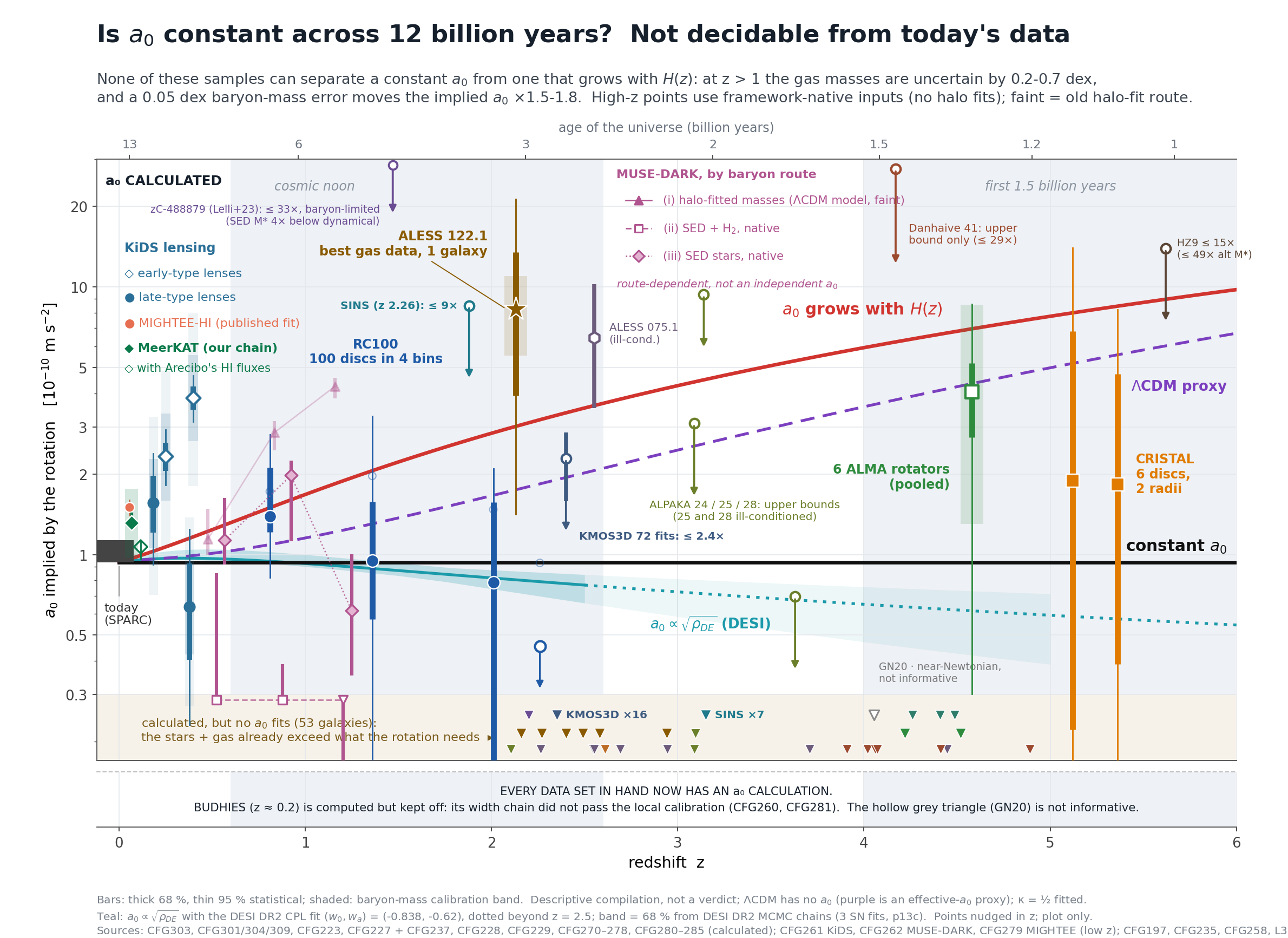
Whether a₀ changes over cosmic time: at high redshift the gas-mass uncertainty is larger than the gap between the flat line and the rival. Also the massive ellipticals, whose gap is not significant with measured tracers.
Fails
Milky Way ultra-faint dwarfs: about 2× too fast, 3.8σ, confirmed from the raw data; tides, binary stars, stellar masses and the Milky Way’s pull are all ruled out. Also structure growth for the bare relativistic theory without the bound-only switch.
Open
Gaia DR4 wide binaries (2 Dec 2026, pre-registered), why κ = ½, what sets the cold-mass amount, and ownership from an action.
Does a₀ change over cosmic time?
The theory predicts a flat line; the rival grows with the expansion rate H(z). The two separate at redshift 2–5, where today’s gas measurements are not yet precise enough to tell them apart.
Full guide and sources: the explainer on GitHub. Next decisive test: Gaia DR4, 2 December 2026.